
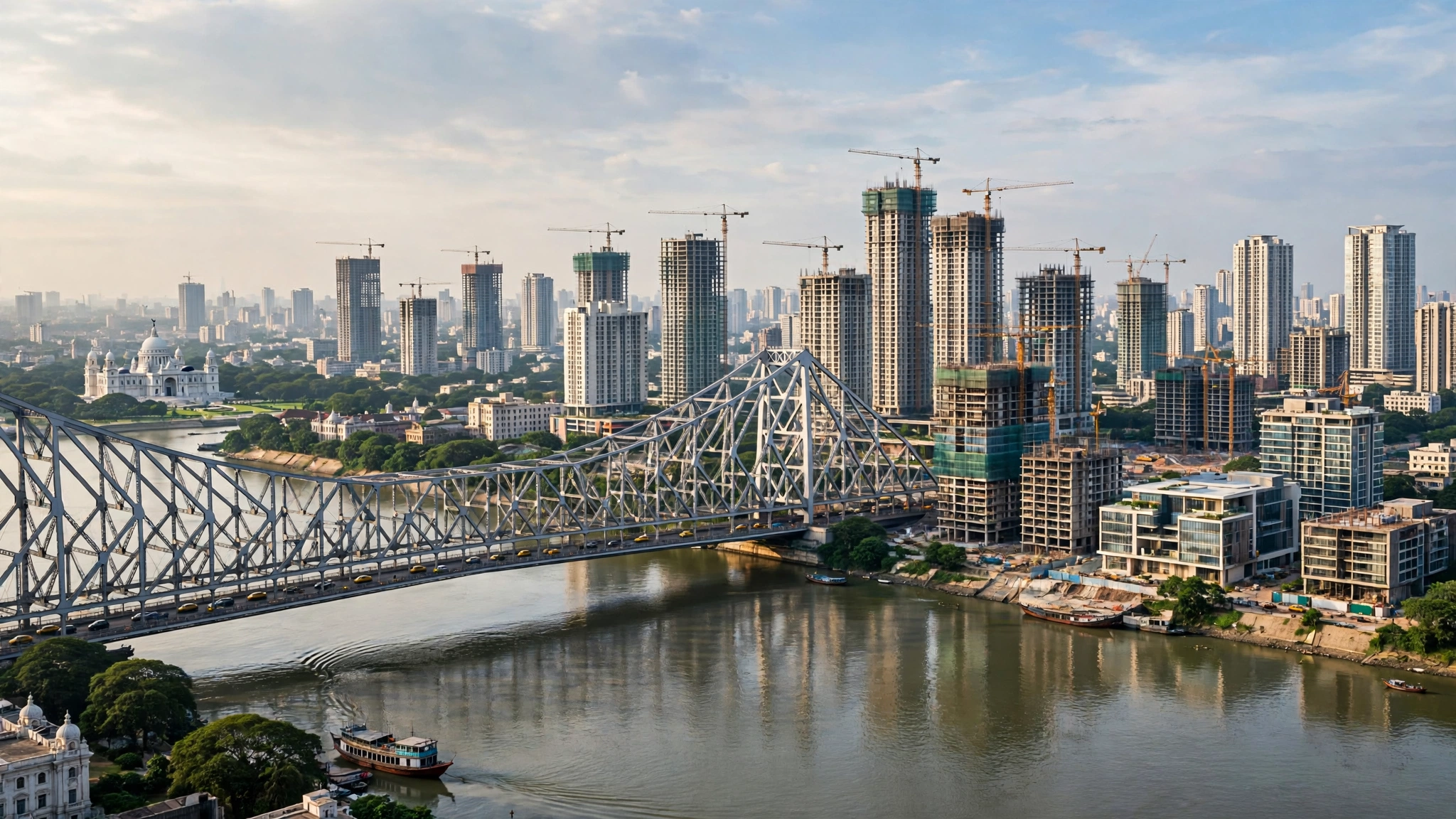
Every year brings a fresh round of predictions about Indian property markets, most of them louder than they are useful. This guide takes a different approach to kolkata real estate trends in 2026: instead of forecasts dressed as facts, it looks at the demand drivers that are actually observable, the micro-markets showing real momentum, and the signals buyers and investors should track. Think of it as a field manual for reading the Kolkata market, not a crystal ball.
BS Group has been developing homes in Kolkata since 1992. We have seen enough cycles to know that fundamentals matter more than trends, but ignoring trends entirely is its own kind of blindness.
How to read property trends without being misled
Most trend reporting suffers from three problems. First, it confuses launches with demand: many new projects launching does not mean many buyers buying. Second, it quotes asking prices as if they were transaction prices; the two can differ meaningfully. Third, it treats the whole city as one market, when a flat in Newtown and a flat in Behala live in different economic realities.
A healthier approach: track what is selling, compare asking prices with recent resale transactions in the same micro-market, and always ask who the buyer is. Kolkata is firmly an end-user market, and that demand behaves very differently from investor demand.
Demand drivers shaping 2026
Continued infrastructure momentum
Infrastructure remains Kolkata’s most reliable demand driver. Metro rail extensions progressively pull new corridors into the commutable city, while flyovers, road upgrades, and improved airport connectivity reshape travel patterns. The trend to watch is the cumulative effect: each year, the set of areas within reasonable commute of major job hubs grows a little larger, and residential demand follows. Buyers who track infrastructure timelines, rather than reacting to completed projects, position themselves ahead of the repricing.
Employment concentration in the east
Growth of IT parks, corporate offices, and institutional campuses around Newtown, Rajarhat, and Sector V keeps concentrating jobs in the city’s east. Rental demand rises first, then purchase demand follows as professionals settle. Corridors serving these hubs, including EM Bypass, benefit from this steady, livelihood-linked demand: people need homes near work in good years and bad.
The affordability advantage persists
Kolkata’s price gap with other large metros remains one of its defining features. As affordability worsens elsewhere, Kolkata becomes relatively more attractive to end users priced out of other cities and to investors seeking accessible entry points. This supports demand across segments, from first-time buyers in corridors like Sodepur and Jessore Road to upgraders in established neighbourhoods.
Preference for ready and near-ready homes
Buyer preference keeps shifting towards ready-to-move or near-completion homes: no waiting for possession, no construction-linked risk, immediate rental income for investors, and the ability to inspect exactly what you are buying. This rewards developers with completed inventory and verifiable delivery records. If you buy under construction in 2026, the developer’s past delivery history matters more than ever.
Quality expectations keep rising
Buyers are more informed than a decade ago. They compare carpet areas, ask about ventilation and natural light, check water supply and power backup, and read society reviews. This rising bar favours serious developers and punishes corner-cutters, because informed buyers can now tell the difference.
The price picture: what can honestly be said
We do not publish price forecasts, because credible ones need transaction-level data that varies street by street. What can be observed qualitatively: established, well-connected corridors show steadier price behaviour, supported by genuine end-user demand and resale liquidity. Emerging corridors near new infrastructure show more variation: some reprice quickly as connectivity improves, others take years to absorb new supply. Affordable corridors remain the most price-sensitive, where small location differences create large demand differences.
The practical takeaway: do not buy on city-level price narratives. For any specific purchase, verify asking prices against recent resale transactions in that exact micro-market, using portals, local brokers, and recent society transactions. Treat launch prices as the start of a negotiation, not as market value. Our guide on comparing residential projects in Kolkata walks through this process.
Micro-markets to watch in 2026
These are corridors where infrastructure, employment, and demand look most interesting this year. None of this is a buy recommendation; each needs on-the-ground verification.
Newtown and Rajarhat
The planned-growth corridor remains Kolkata’s most watched micro-market, with employment concentration, institutional development, and metro connectivity keeping demand active. The watch-out is pricing: expectations are already high, so compare carefully against resale options and avoid overpaying for the newness premium. End users buying to live near work have the clearest case. Our BS Nest project is located in Newtown.
EM Bypass
The Bypass has matured into a dependable residential and commercial spine connecting the south to Salt Lake, Sector V, and Newtown. Its profile is steadiness rather than excitement: consistent demand, active rental markets, good resale liquidity. For risk-averse buyers and yield-focused investors, dependable beats exciting.
Dum Dum and the northern corridor
Metro connectivity and airport proximity keep Dum Dum relevant for end users and investors alike: a middle path between central prices and far-suburb distances. Pragati Dham, in Dum Dum Cantonment, illustrates the area’s long-standing appeal. Watch how infrastructure improvements affect specific pockets differently along this corridor.
Sodepur and Jessore Road
The affordability corridor. Lower entry prices keep first-time buyers and budget investors active, and infrastructure improvements land disproportionately because the base is low. The trend here is selective: well-connected pockets near transit outperform the corridor average significantly, so homework pays the most. Our Sai Enclave on Jessore Road sits in this belt.
Salt Lake
Salt Lake remains one of Kolkata’s most established planned neighbourhoods, with enduring demand from professionals and families. Its story is stability and scarcity rather than rapid change: limited new supply in a mature, well-regarded area. Resale dynamics here reward patience and careful negotiation.
What buyers should track through 2026
- New supply in your target micro-market: many simultaneous launches can soften prices and improve your negotiating position.
- The gap between asking prices and actual resale transactions: a wide gap means room to negotiate.
- Infrastructure timelines near shortlisted areas: corridors about to gain connectivity often offer better value than those where improvement is already priced in.
- Developer delivery records: in a market favouring ready homes, completed projects are the real brochure. Ours span three decades; browse our projects and our story.
- Your own financing: track home loan rate movements and get eligibility assessed early, so you can move when the right property appears.
Before any booking, work through our checklists: documents to verify, what to check during a site visit, and questions to ask the developer.
What investors should track through 2026
- Rental demand indicators: occupancy levels, time-to-let for comparable flats, and tenant profile in the target area.
- Upcoming supply: the biggest risk to rents and resale values is a wave of new completions hitting together.
- Infrastructure catalysts with dates: a metro stretch opening next year affects a different decision than one opening in five years.
- Regulatory developments: RERA enforcement trends and changes to stamp duty or registration costs affect your total return. Verify current figures on official portals.
- Your exit options: before buying, understand who your future buyer or tenant will be. Investment property without a clear exit audience is an expensive hope.
Red flags in a trending market
Trends attract opportunists. Watch for these regardless of how hot a micro-market seems:
- Prices rising much faster than rents in the same area, which compresses yields and suggests speculation.
- Developers with no completed projects launching large phases on hype alone.
- Pressure tactics: “prices go up next week” is a sales script, not market analysis.
- Projects marketed on infrastructure that is planned but unfunded or years away.
- Anyone guaranteeing returns or appreciation percentages. Genuine trends describe probabilities; guarantees describe fraud.
Frequently Asked Questions
What is the biggest Kolkata real estate trend in 2026?
Infrastructure-led demand: metro expansion and employment concentration in the east keep reshaping which corridors are desirable. Layered on top is buyer preference for ready or near-ready homes from developers with verifiable delivery records.
Are Kolkata property prices rising in 2026?
It varies sharply by micro-market. Well-connected corridors show steadier trends supported by end-user demand; emerging corridors are more variable. Verify current prices against recent resale transactions in your specific target area.
Which Kolkata micro-markets are emerging as hotspots?
Corridors combining infrastructure momentum with employment access look most active: Newtown/Rajarhat, EM Bypass, Dum Dum, and selective pockets of Sodepur/Jessore Road. Each needs on-the-ground verification of prices, supply pipeline, and rental demand.
Is 2026 a good year to buy property in Kolkata?
For end users with stable finances and a long horizon, buying right beats timing: fair price, good location, verified paperwork, reliable developer. For investors, selectivity wins.
How do I verify price trends in a specific Kolkata area?
Compare asking prices on portals with recent resale transactions in the same locality, track how long listings stay active, and use rental listings as a cross-check on demand. Treat launch prices as negotiable starting points.
Should I worry about oversupply in Kolkata’s new corridors?
It is a valid concern where many launches complete together. Before buying, assess how much new supply arrives over the next two to three years and whether demand can absorb it. Established corridors with limited new supply carry less of this risk.
Read the market with people who have watched it for 30 years
Trends are useful, but no substitute for walking a site, checking paperwork, and talking to people who have built through multiple cycles. If you are buying or investing in Kolkata in 2026, BS Group can give you a grounded view: real projects across the city’s key corridors, three decades of delivery history, and straight answers.
Call us on +91 7044559552 or reach out via our Kolkata Real Estate Trends 2026: Prices, Demand & Upcoming Hotspots
Every year brings a fresh round of predictions about Indian property markets, most of them louder than they are useful. This guide takes a different approach to kolkata real estate trends in 2026: instead of forecasts dressed as facts, it looks at the demand drivers that are actually observable, the micro-markets showing real momentum, and the signals buyers and investors should track. Think of it as a field manual for reading the Kolkata market, not a crystal ball.
BS Group has been developing homes in Kolkata since 1992. We have seen enough cycles to know that fundamentals matter more than trends, but ignoring trends entirely is its own kind of blindness.
How to read property trends without being misled
Most trend reporting suffers from three problems. First, it confuses launches with demand: many new projects launching does not mean many buyers buying. Second, it quotes asking prices as if they were transaction prices; the two can differ meaningfully. Third, it treats the whole city as one market, when a flat in Newtown and a flat in Behala live in different economic realities.
A healthier approach: track what is selling, compare asking prices with recent resale transactions in the same micro-market, and always ask who the buyer is. Kolkata is firmly an end-user market, and that demand behaves very differently from investor demand.
Demand drivers shaping 2026
Continued infrastructure momentum
Infrastructure remains Kolkata’s most reliable demand driver. Metro rail extensions progressively pull new corridors into the commutable city, while flyovers, road upgrades, and improved airport connectivity reshape travel patterns. The trend to watch is the cumulative effect: each year, the set of areas within reasonable commute of major job hubs grows a little larger, and residential demand follows. Buyers who track infrastructure timelines, rather than reacting to completed projects, position themselves ahead of the repricing.
Employment concentration in the east
Growth of IT parks, corporate offices, and institutional campuses around Newtown, Rajarhat, and Sector V keeps concentrating jobs in the city’s east. Rental demand rises first, then purchase demand follows as professionals settle. Corridors serving these hubs, including EM Bypass, benefit from this steady, livelihood-linked demand: people need homes near work in good years and bad.
The affordability advantage persists
Kolkata’s price gap with other large metros remains one of its defining features. As affordability worsens elsewhere, Kolkata becomes relatively more attractive to end users priced out of other cities and to investors seeking accessible entry points. This supports demand across segments, from first-time buyers in corridors like Sodepur and Jessore Road to upgraders in established neighbourhoods.
Preference for ready and near-ready homes
Buyer preference keeps shifting towards ready-to-move or near-completion homes: no waiting for possession, no construction-linked risk, immediate rental income for investors, and the ability to inspect exactly what you are buying. This rewards developers with completed inventory and verifiable delivery records. If you buy under construction in 2026, the developer’s past delivery history matters more than ever.
Quality expectations keep rising
Buyers are more informed than a decade ago. They compare carpet areas, ask about ventilation and natural light, check water supply and power backup, and read society reviews. This rising bar favours serious developers and punishes corner-cutters, because informed buyers can now tell the difference.
The price picture: what can honestly be said
We do not publish price forecasts, because credible ones need transaction-level data that varies street by street. What can be observed qualitatively: established, well-connected corridors show steadier price behaviour, supported by genuine end-user demand and resale liquidity. Emerging corridors near new infrastructure show more variation: some reprice quickly as connectivity improves, others take years to absorb new supply. Affordable corridors remain the most price-sensitive, where small location differences create large demand differences.
The practical takeaway: do not buy on city-level price narratives. For any specific purchase, verify asking prices against recent resale transactions in that exact micro-market, using portals, local brokers, and recent society transactions. Treat launch prices as the start of a negotiation, not as market value. Our guide on comparing residential projects in Kolkata walks through this process.
Micro-markets to watch in 2026
These are corridors where infrastructure, employment, and demand look most interesting this year. None of this is a buy recommendation; each needs on-the-ground verification.
Newtown and Rajarhat
The planned-growth corridor remains Kolkata’s most watched micro-market, with employment concentration, institutional development, and metro connectivity keeping demand active. The watch-out is pricing: expectations are already high, so compare carefully against resale options and avoid overpaying for the newness premium. End users buying to live near work have the clearest case. Our BS Nest project is located in Newtown.
EM Bypass
The Bypass has matured into a dependable residential and commercial spine connecting the south to Salt Lake, Sector V, and Newtown. Its profile is steadiness rather than excitement: consistent demand, active rental markets, good resale liquidity. For risk-averse buyers and yield-focused investors, dependable beats exciting.
Dum Dum and the northern corridor
Metro connectivity and airport proximity keep Dum Dum relevant for end users and investors alike: a middle path between central prices and far-suburb distances. Pragati Dham, in Dum Dum Cantonment, illustrates the area’s long-standing appeal. Watch how infrastructure improvements affect specific pockets differently along this corridor.
Sodepur and Jessore Road
The affordability corridor. Lower entry prices keep first-time buyers and budget investors active, and infrastructure improvements land disproportionately because the base is low. The trend here is selective: well-connected pockets near transit outperform the corridor average significantly, so homework pays the most. Our Sai Enclave on Jessore Road sits in this belt.
Salt Lake
Salt Lake remains one of Kolkata’s most established planned neighbourhoods, with enduring demand from professionals and families. Its story is stability and scarcity rather than rapid change: limited new supply in a mature, well-regarded area. Resale dynamics here reward patience and careful negotiation.
What buyers should track through 2026
- New supply in your target micro-market: many simultaneous launches can soften prices and improve your negotiating position.
- The gap between asking prices and actual resale transactions: a wide gap means room to negotiate.
- Infrastructure timelines near shortlisted areas: corridors about to gain connectivity often offer better value than those where improvement is already priced in.
- Developer delivery records: in a market favouring ready homes, completed projects are the real brochure. Ours span three decades; browse our projects and our story.
- Your own financing: track home loan rate movements and get eligibility assessed early, so you can move when the right property appears.
Before any booking, work through our checklists: documents to verify, what to check during a site visit, and questions to ask the developer.
What investors should track through 2026
- Rental demand indicators: occupancy levels, time-to-let for comparable flats, and tenant profile in the target area.
- Upcoming supply: the biggest risk to rents and resale values is a wave of new completions hitting together.
- Infrastructure catalysts with dates: a metro stretch opening next year affects a different decision than one opening in five years.
- Regulatory developments: RERA enforcement trends and changes to stamp duty or registration costs affect your total return. Verify current figures on official portals.
- Your exit options: before buying, understand who your future buyer or tenant will be. Investment property without a clear exit audience is an expensive hope.
Red flags in a trending market
Trends attract opportunists. Watch for these regardless of how hot a micro-market seems:
- Prices rising much faster than rents in the same area, which compresses yields and suggests speculation.
- Developers with no completed projects launching large phases on hype alone.
- Pressure tactics: “prices go up next week” is a sales script, not market analysis.
- Projects marketed on infrastructure that is planned but unfunded or years away.
- Anyone guaranteeing returns or appreciation percentages. Genuine trends describe probabilities; guarantees describe fraud.
Frequently Asked Questions
What is the biggest Kolkata real estate trend in 2026?
Infrastructure-led demand: metro expansion and employment concentration in the east keep reshaping which corridors are desirable. Layered on top is buyer preference for ready or near-ready homes from developers with verifiable delivery records.
Are Kolkata property prices rising in 2026?
It varies sharply by micro-market. Well-connected corridors show steadier trends supported by end-user demand; emerging corridors are more variable. Verify current prices against recent resale transactions in your specific target area.
Which Kolkata micro-markets are emerging as hotspots?
Corridors combining infrastructure momentum with employment access look most active: Newtown/Rajarhat, EM Bypass, Dum Dum, and selective pockets of Sodepur/Jessore Road. Each needs on-the-ground verification of prices, supply pipeline, and rental demand.
Is 2026 a good year to buy property in Kolkata?
For end users with stable finances and a long horizon, buying right beats timing: fair price, good location, verified paperwork, reliable developer. For investors, selectivity wins.
How do I verify price trends in a specific Kolkata area?
Compare asking prices on portals with recent resale transactions in the same locality, track how long listings stay active, and use rental listings as a cross-check on demand. Treat launch prices as negotiable starting points.
Should I worry about oversupply in Kolkata’s new corridors?
It is a valid concern where many launches complete together. Before buying, assess how much new supply arrives over the next two to three years and whether demand can absorb it. Established corridors with limited new supply carry less of this risk.
Read the market with people who have watched it for 30 years
Trends are useful, but no substitute for walking a site, checking paperwork, and talking to people who have built through multiple cycles. If you are buying or investing in Kolkata in 2026, BS Group can give you a grounded view: real projects across the city’s key corridors, three decades of delivery history, and straight answers.
Call us on +91 7044559552 or reach out via our contact page to book a site visit. Bring this guide’s checklist; we will work through it together. to book a site visit. Bring this guide’s checklist; we will work through it together.