
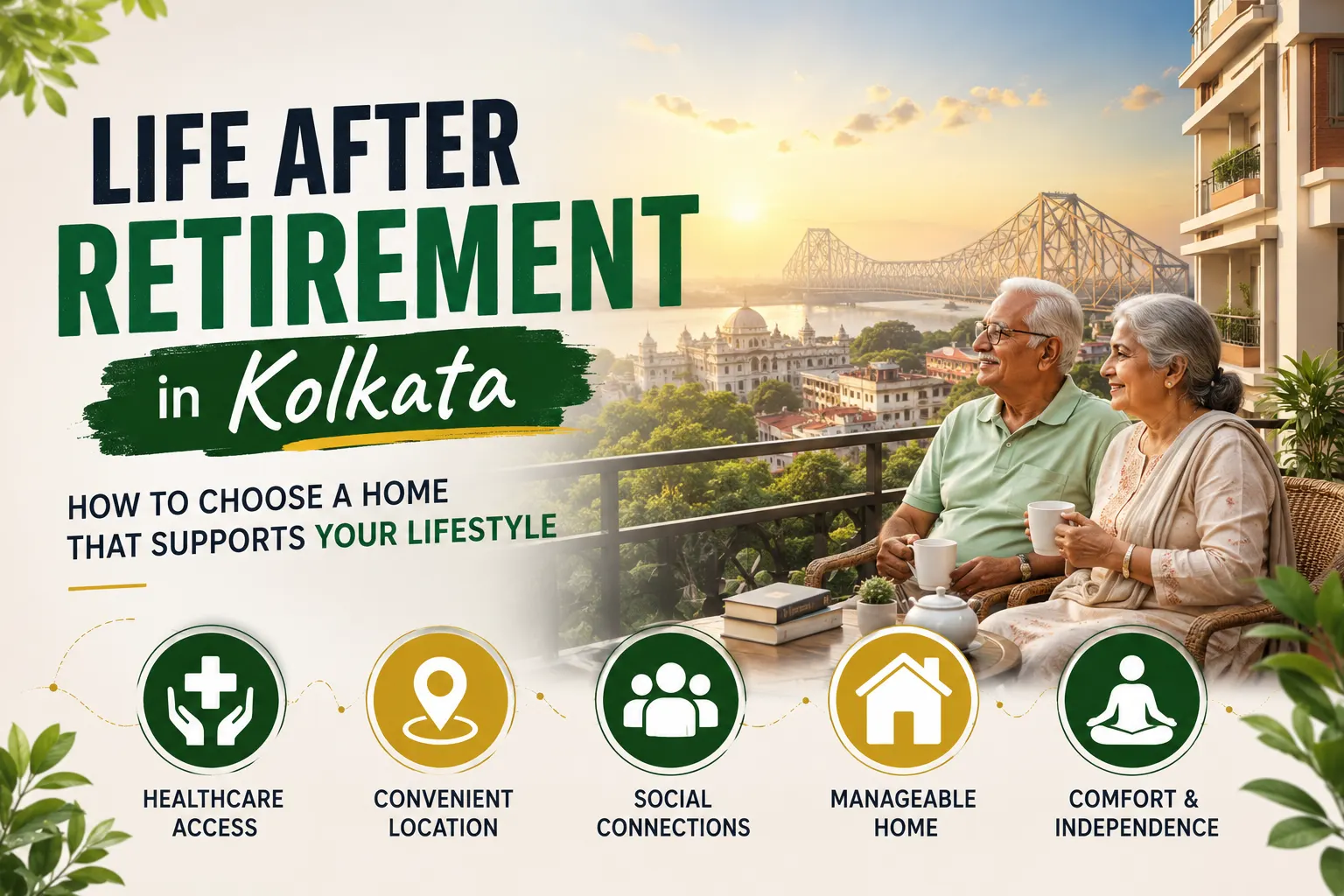
Retirement brings a major change in the way people think about home and everyday living. During working life, many property decisions are influenced by office location, commute time, children’s schools or the need for a larger family home.
After retirement, priorities can change.
A comfortable lifestyle may depend more on daily convenience, healthcare access, social connections, a manageable home and the freedom to continue living independently.
For people planning life after retirement in Kolkata, choosing the right home is not only a real estate decision. It is also a lifestyle decision.
The question is not simply, “How big should the home be?” A more useful question is:
Will this home and its location make everyday life easier, more comfortable and enjoyable after retirement?
Problem 1: The Home Was Chosen for Working Life, Not Retirement
Many people continue living in homes that were perfect for an earlier stage of life.
The property may have been chosen because it was close to the workplace, suitable for a growing family or large enough for children.
After retirement, the same home may no longer match everyday requirements.
For example, the property may:
- Require significant maintenance
- Be located far from family
- Have difficult access to daily services
- Require frequent use of stairs
- Have more space than is actually needed
- Be inconvenient for healthcare visits
The Solution: Reassess What Matters Now
Retirement can be a good time to reconsider personal priorities.
Ask yourself:
- How do I want to spend my day?
- Which places do I visit regularly?
- How important is healthcare access?
- Do I want to be closer to family?
- Do I prefer a peaceful neighbourhood or a more active environment?
- Is my current home easy to maintain?
The answers can help determine whether the current home remains suitable or whether a different residential environment may offer better long-term comfort.
Problem 2: A Large Home Can Become Difficult to Manage
A large house or apartment may have been useful when children and other family members were living together.
After children move out, several rooms may remain unused.
Cleaning, maintenance and general management can become more demanding than necessary.
The Solution: Focus on a Manageable Lifestyle
More space is not always better.
A practical home should provide enough room for comfortable living without creating unnecessary responsibilities.
When evaluating a property, consider:
- Number of rooms actually required
- Ease of maintenance
- Storage requirements
- Apartment layout
- Ease of movement
- Cleaning requirements
- Natural light and ventilation
For retirement living in Kolkata, a well-planned home may offer more value than simply choosing the largest available property.
Problem 3: Daily Life Can Become Inconvenient Because of the Location
A property may be located in a desirable area but still be inconvenient for a retired person’s everyday routine.
After retirement, office connectivity may become less important, while access to markets, healthcare, pharmacies and family may become more relevant.
The Solution: Choose a Location Based on Everyday Needs
Before selecting a home, think about the places you may visit regularly.
These could include:
- Hospitals
- Clinics
- Pharmacies
- Markets
- Grocery stores
- Banks
- ATMs
- Family homes
- Friends
- Community spaces
- Transportation points
A suitable location should support your actual lifestyle rather than simply having a popular address.
Problem 4: Retirement Can Reduce Everyday Social Interaction
Working life naturally creates a routine of meeting people.
After retirement, that routine can change.
Children may have busy schedules, friends may live far away and former colleagues may no longer be part of everyday life.
Without regular interaction, some people may begin spending more time alone than they prefer.
The Solution: Choose a Lifestyle That Keeps You Connected
Retirement does not mean that social life has to become smaller.
Consider activities such as:
- Meeting friends
- Spending time with family
- Interacting with neighbours
- Pursuing hobbies
- Attending local activities
- Taking regular walks
- Exploring cultural interests
- Learning new skills
When choosing a residential environment, think about whether the location supports the kind of social life you want.
Some people may prefer a quiet and peaceful environment.
Others may enjoy being closer to familiar neighbourhoods and everyday activity.
The right choice depends on personal preference.
Problem 5: Healthcare May Become a More Important Part of Location Planning
Healthcare is often not a major factor when younger people choose a home.
After retirement, convenient access to doctors, clinics, pharmacies and hospitals may become more important.
A location that requires complicated travel for routine appointments can create unnecessary inconvenience.
The Solution: Research Healthcare Accessibility Before Choosing
When evaluating a neighbourhood, look at the practical accessibility of:
- Hospitals
- Doctors
- Clinics
- Diagnostic centres
- Pharmacies
Do not make assumptions based only on general claims about the location.
Understand the actual routes and how convenient they are for everyday use.
For senior citizens living in Kolkata, healthcare access can be an important part of long-term residential planning.
Problem 6: Independence Can Become Difficult Without Daily Convenience
Many retired people want to continue managing their own routine.
They may enjoy going to the market, meeting friends, visiting nearby places or handling personal errands.
However, if every activity requires long-distance travel or dependence on family members, maintaining independence can become more difficult.
The Solution: Choose Convenience Without Sacrificing Independence
Look at how easily everyday activities can be managed.
Consider access to:
- Grocery stores
- Markets
- Pharmacies
- Banks
- Transportation
- Local services
- Social spaces
The objective is not to have everything immediately next to the home.
The important question is whether everyday life can be managed conveniently.
Problem 7: The Home May Not Support Changing Requirements
A home can feel perfectly comfortable today but become less practical over time.
Stairs, difficult bathroom access, narrow movement areas or inconvenient layouts may eventually create challenges.
The Solution: Think About Long-Term Usability
When choosing a retirement home, look beyond current requirements.
Consider:
- Ease of entering the building
- Lift availability where required
- Ease of movement inside the apartment
- Bedroom accessibility
- Bathroom usability
- Kitchen layout
- Lighting
- Maintenance requirements
Planning ahead does not mean assuming future problems.
It simply means choosing a home that is more likely to remain practical as lifestyle requirements change.
Problem 8: Families Want to Help but Parents Want Their Independence
This can be one of the most common challenges after retirement.
Adult children may want their parents to live closer, move to a different home or accept more support.
Parents may prefer to maintain their existing routine and independence.
The Solution: Make Property Decisions Together
A new home should not be selected only because family members believe it is convenient.
The person who will live there should be actively involved in the decision.
Discuss:
- Preferred neighbourhood
- Daily routine
- Access to friends
- Healthcare needs
- Family visits
- Home size
- Lifestyle preferences
The best solution should balance practical support with personal independence.
Problem 9: Retirement Can Feel Like Losing a Daily Routine
Work often provides structure.
After retirement, people suddenly have more control over their time, but some may find it difficult to create a new routine.
The Solution: Build a Lifestyle Around Personal Interests
Retirement can create opportunities to focus on activities that were previously difficult to prioritise.
This may include:
- Reading
- Gardening
- Cooking
- Teaching
- Mentoring
- Art
- Music
- Writing
- Volunteering
- Learning
- Spending time with family
A home and neighbourhood should support these interests where possible.
The goal is not to stay busy every minute.
It is to maintain activities that provide enjoyment and a sense of purpose.
Problem 10: The Existing Neighbourhood May No Longer Match Your Lifestyle
People often become attached to the neighbourhood where they have lived for many years.
However, lifestyle requirements can change.
The neighbourhood may become inconvenient because:
- Essential services have become difficult to access
- Family members have moved elsewhere
- Healthcare requirements have changed
- The home itself requires too much maintenance
- Transportation is no longer practical
The Solution: Evaluate the Complete Living Environment
Instead of looking only at the apartment, evaluate:
Home + Building + Neighbourhood + Healthcare + Daily Services + Transportation + Family Connection
These factors together influence the quality of life after retirement.
A beautiful apartment may not offer the right lifestyle if the surrounding environment creates daily difficulties.
How to Plan a Comfortable Life After Retirement in Kolkata
Before choosing a home, create a clear list of priorities.
Step 1: Think About Your Preferred Lifestyle
Ask yourself:
- Do I prefer a peaceful environment?
- Do I want to remain close to friends?
- How often do I expect family members to visit?
- Do I enjoy going out regularly?
- Do I want easy access to markets and services?
- How important is healthcare access?
There is no universal answer.
The best retirement lifestyle is the one that matches your personal preferences.
Step 2: Evaluate the Neighbourhood
Visit the area and explore the surroundings.
Consider:
- Daily shopping options
- Healthcare access
- Transportation
- Walkability and everyday movement
- Family connectivity
- Local services
- Social opportunities
Try to understand what living in the area would actually feel like.
Step 3: Evaluate the Building
Check practical factors such as:
- Entrance accessibility
- Lift availability where required
- Common areas
- Lighting
- Security arrangements
- Visitor access
Step 4: Evaluate the Apartment
Look at:
- Layout
- Ease of movement
- Bedroom location
- Bathroom usability
- Kitchen practicality
- Natural light
- Ventilation
- Storage
- Maintenance requirements
Step 5: Think About Long-Term Comfort
A home should not only work today.
Consider whether it can remain practical and comfortable as your lifestyle changes.
What Makes a Good Home for Life After Retirement?
There is no single type of property that works for everyone.
However, a comfortable retirement home should generally support:
Independence
The ability to manage everyday activities comfortably.
Accessibility
Easy movement inside the apartment and building.
Daily Convenience
Practical access to groceries, medicines and other essential services.
Healthcare Access
Convenient access to doctors, clinics and other healthcare services.
Family Connection
A location where family members can visit without unnecessary difficulty.
Social Interaction
Opportunities to maintain friendships and personal interests.
Manageable Maintenance
A home that does not create unnecessary responsibilities.
Long-Term Usability
A property that can remain practical over time.
How Families Can Help Parents Plan Life After Retirement
Families can play an important role without taking control of every decision.
Helpful support may include:
- Discussing future housing requirements
- Exploring different neighbourhoods together
- Understanding daily priorities
- Helping compare properties
- Considering long-term comfort
- Maintaining regular communication
- Respecting personal preferences
The most successful decisions are usually made through discussion rather than pressure.
Life After Retirement Is About More Than Where You Live
The right home can support a better lifestyle, but the property itself is only one part of the decision.
A fulfilling retirement lifestyle may include:
- Personal independence
- Meaningful activities
- Family connection
- Friendships
- Healthcare convenience
- A comfortable home
- A supportive neighbourhood
When these factors are considered together, choosing the right residential environment becomes easier.
Exploring Residential Options in Kolkata
When comparing homes, avoid selecting a property based only on size, price or appearance.
Instead, evaluate how the apartment and surrounding environment support the lifestyle you want after retirement.
You can explore residential properties in Kolkata and compare different options based on location, accessibility and long-term lifestyle requirements.
It can also be useful to learn more about how to choose the right location for your home in Kolkata before making a final decision.
A Practical Retirement Home Checklist
Before choosing a home, ask:
- Does the location support my daily routine?
- Are healthcare facilities reasonably accessible?
- Can I manage essential shopping conveniently?
- Is transportation practical?
- Can family and friends visit easily?
- Is the building easy to access?
- Is the apartment comfortable to move around?
- Is the home easy to maintain?
- Does the neighbourhood match my preferred lifestyle?
- Will the property remain practical in the future?
A home that answers these questions positively may be worth considering further.
Final Thoughts
Life after retirement in Kolkata can be an opportunity to create a more comfortable and personally meaningful lifestyle.
The right home should not simply provide a place to live. It should support independence, daily convenience, healthcare access, social interaction and family connection.
Instead of choosing a property based only on its size or appearance, think about how it will support everyday life.
The best retirement home is one that makes daily living easier while allowing you to continue enjoying the people, activities and routines that matter to you.
Frequently Asked Questions
What should I consider when choosing a home after retirement in Kolkata?
Consider daily convenience, accessibility, healthcare access, transportation, family connection, maintenance requirements and your preferred lifestyle.
Is it better to move to a smaller home after retirement?
Not always. The right home size depends on individual requirements. However, a manageable and practical home may be easier to maintain than a larger property with unused space.
How important is location after retirement?
Location can become especially important because access to healthcare, markets, pharmacies, family, friends and transportation may influence everyday convenience.
How can retired people maintain an independent lifestyle?
A practical home, convenient neighbourhood, accessible essential services, social interaction and appropriate family support can help maintain independence.
Should retired parents live close to their children?
This depends on personal preferences and family circumstances. However, convenient connectivity can make family visits and practical support easier.
What makes a neighbourhood suitable for retirement living?
A suitable neighbourhood may offer practical access to healthcare, daily services, transportation, family and opportunities for social interaction.
How can families help parents choose a retirement home?
Families can discuss priorities, explore locations together, compare practical factors and involve parents in every important decision.
What is the most important factor when choosing a retirement home?
There is no single factor. The best decision usually considers the combination of home comfort, accessibility, location, healthcare, independence and lifestyle preferences.